
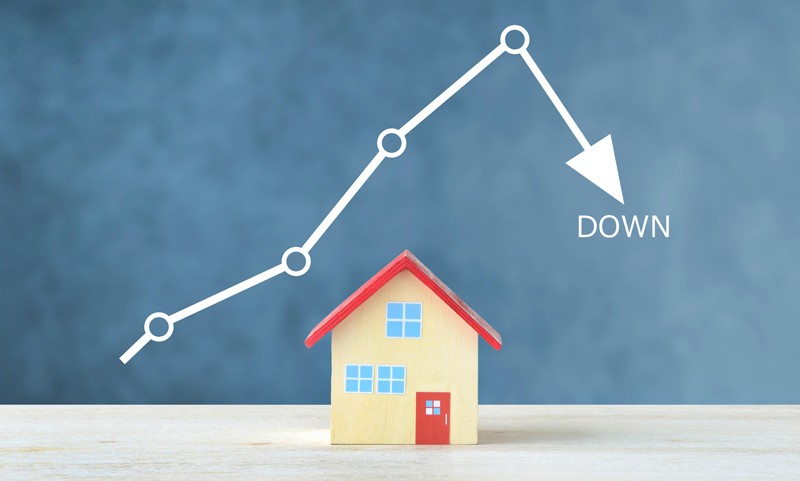
As the spring housing season wraps up this month, a great number of prospective buyers and sellers are held back as both pending home sales and mortgage applications continue on a downward trend. For buyers, high property prices, continually elevated mortgage rates, and an unstable economy set the stage for their hesitancy to move forward with a deal. Sellers are feeling the brunt of this as their properties get lumped into housing inventory levels that have risen to a five-year high.
Recent stats for April show existing home sales dipped to a low level not seen since 2009 at this time of year, with the numbers including 4 million properties sold on a seasonally adjusted annual basis. This comes to a 0.5% drop from March and a 2% drop year over year.
Mortgage Applications Continue to Fall in Numbers
As reported by the Mortgage Bankers Association’s (MBA) recent Weekly Mortgage Applications Survey, for the week ending May 30, applications dipped 3.9% on a seasonally adjusted basis. This lowers mortgage application numbers for the third consecutive week, highlighting the trend of decreased buyer demand.
Applications for mortgages dropped by 39% from the same week in 2019, prior to the start of the pandemic. In the years following, home prices began surging, along with mortgage rates, making a home purchase almost impossible for the average buyer.
Related Article: March Home Sales Fell 5.9% – Largest Decline in Over Two Years
Although mortgage rates have dipped slightly this week, they are still hovering near the 7% range, and so these small drops are not making an impact when it comes to improving housing market activity. Joel Kan, MBA’s vice president and deputy chief economist, makes a note of this, stating, “Most mortgage rates moved lower last week, with the 30-year fixed rate declining to 6.92% and staying in the 6.8% to 7% range since April.” “Refinance activity fell across both conventional and government segments, and the overall average refinance loan size was the smallest since July 2024, as potential borrowers hold out for larger rate drops,” adds Kan.
Pending Home Sales Hits New Low
As reported by the National Association of Realtors (NAR) this week, pending home sales across the nation tanked overall by 6.3% this past April from the previous month. On a regional level, the West was hit the hardest, with pending sales dropping 8.9% to an index of 53.3, which is down 6.5% as compared to April of last year. The Midwest saw a 5.0% decrease in pending sales from March, yet experienced a 2.2% annual increase, reaching 73.5. The South saw a monthly decline of 7.7%, bringing its index to 85.9, which represents a 3.0% drop compared to the prior year. At 0.6%, the Northeast had the smallest monthly decrease, bringing its index to 62.1, marking a 3.0% year-over-year drop.
If you’re not familiar with the term “pending home sales” and its importance, here’s a quick explanation from Mortgage Point: NAR’s Pending Home Sales Index (PHSI) is based on pending sales of existing homes. A sale is listed as pending when the contract has been signed, but the transaction has not closed, though the sale usually is finalized within one or two months of signing. Pending contracts are good early indicators of upcoming sales closings.
Related Article: Pending Home Sales See Record Cancellation Rates as More People Turn to Rentals
Rising Inventory and a Shifting Market

At one point, a limited housing supply was one of the main reasons buyers were locked out of the market. However, at this time, inventory is climbing to the point where sellers are offering incentives, but even so, demand is still on the decline. In fact, we’re seeing the highest level of homes on the market since before the pandemic.
On average, homes are taking longer to sell, with a median of 51 days on the market, an increase of six days from a year prior. The greatest rise in housing inventory compared to pre-pandemic levels among the 50 largest metros tracked by Realtor.com, was seen in Denver, Austin, Seattle, San Antonio, and Dallas.
“The number of homes for sale is growing, and even hit a key milestone in May, with more than a million active listings,” says Danielle Hale, Realtor.com chief economist.
With pending home sales dropping at this level as buyers turn their backs, what’s the answer? Lower mortgage rates that will give buyers a break in monthly payments would help, as well as lower property prices. On top of this, buyers are concerned about their jobs, the economy, pending wars, tariffs, and similar, where there really is no simple answer to what lies ahead.
Investors Capitalize on Pending Home Sales Falling
With mortgage applications down and pending home sales at low levels, families that are turning away from buying a house are now looking at rentals to live out the American dream. Owning a home at this time is just not feasible for the average worker. In fact, the situation is worsening as the earnings required to own a home are up 5% year over year – buyers just can’t seem to catch a break.
Related Article: Homeowners Must Earn 81.8 Percent More Than Renters to Make Home Affordability Possible
After being forced to reevaluate, what these prospective buyers are realizing, is that renting a home is not just more affordable, but also much more convenient. With a rental, they’re not locked into a lifetime property with a 30-year mortgage, they can move at any point, and the home comes with all the perks and appliances as a purchased home would – where all the repair costs are covered by the property owner, not them. Insurance and property taxes are off their plate as well.
This all puts real estate investors in a favorable position where potential tenants are lining up for rentals. In addition to this, with the state of the economy, owning a rental is a wise investment that’s safe from the impact of the declining U.S. dollar, and acts as a hedge against inflation.
Invest in Rental Real Estate
If you’d like to invest your funds into a safe asset that holds its ground, reach out to our team to schedule a complimentary call. We specialize in building new construction rental properties in high-demand areas that sport thriving economies. It’s also worth mentioning that we place a vetted tenant and experienced property manager for you as well so you can start cash flowing from the start.
If you’re not at a point where you feel a rental real estate purchase is possible because you require more funds for the downpayment, you can ramp up the process by earning 7.5-9% annual returns on sums of $500 or more with real estate short notes through Connect Invest. Additionally, you can get a $50 wallet credit when you sign up through our Connect Invest page. It’s a great way to invest in real estate without actually purchasing a property.
In the meantime, dive into the following video that covers How to Easily Buy a Rental Property Before the End of The Year: